
From the Friars to the Council of Constance
The friars preach in the towns, Aquinas builds a system of theology, the papacy moves to Avignon, the Black Death kills a large part of Europe's people, two and then three popes claim the church, and the Council of Constance burns Jan Hus and ends the schism.
The schism and the councils
Oxford and Prague, Paris, Assisi, Lyons, Avignon and Rome, Constance, Constantinople, and the battlefield of Kosovo. No borders are drawn.
Images from the period
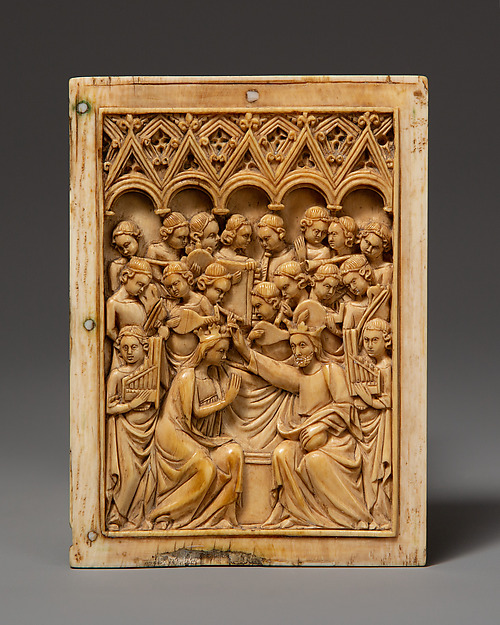
Overview
The seventh era ended at the Fourth Lateran Council in 1215. This era runs from there to the Council of Constance, which ended the Great Western Schism in 1417. In those years the friars and the universities changed the church’s teaching and work, the papacy made its largest claims and then left Rome for Avignon, the Black Death killed a large part of Europe’s people, and the Western church divided under two and then three popes. It ends with the council that burned Jan Hus.
The page is arranged by East and West, as before. The East appears only in a few rows, because the era is mainly Western.
When were the sources written?
| Writing | Usual date | Notes |
|---|---|---|
| Boccaccio, Decameron, introduction | After the plague of 1348 | Payne’s translation, 1886 |
| Boniface VIII, Unam Sanctam | 18 November 1302 | Read in Schaff’s translation |
| Schaff, History of the Christian Church, vols. 5 and 6 | 1907 and 1910 | A Protestant church history, used for events and dates |
| The Catholic Encyclopedia | The 1913 edition, on Wikisource | A Catholic reference work, used for events and dates |
| Gibbon, Decline and Fall | 1776 to 1789 | Used here only for Kosovo |
Key debates
Did the papacy hold power over kings?
Unam Sanctam claimed that it did, and declared subjection to the Roman pontiff “altogether necessary to salvation”. Schaff, a Protestant, calls it the claim “in its extreme form” and lists it among the most notorious deliverances of the popes. Within a year Boniface had been humiliated at Anagni by Philip’s men, and his successors lived in France.
Why did the papacy move to Avignon?
Schaff says the way had been prepared: popes had often taken refuge in France, the papacy had leaned on France against the emperors, and in 1305 the French party in the conclave won the election of a French archbishop, who never crossed the Alps. He calls the Avignon years a great shock to the papal system. The page does not go beyond what the sources say.
Could a council reform the church?
At Constance the council removed three rival popes and decreed that general councils should meet regularly. Schaff notes that the decrees became a platform for those who limited the pope’s authority, and that Martin V’s approval of the council’s decrees was worded so that its meaning is still argued. The council also condemned Hus, who had come under a safe-conduct.
Worship and community life
Friars and towns
The Dominicans were founded as an order of preachers, and the Franciscans as brothers living in poverty and preaching. Both became teachers in the universities: Aquinas, a Dominican, taught at Paris. Schaff treats them together as the mendicant orders.
The Black Death and the parish
Schaff says the clergy died in great numbers in 1348 and 1349. In England the bishops let any cleric give absolution, ordained men before the canonical age, and found that priests who survived could ask far higher stipends. He says the effect on the church was to interrupt its ministries and perhaps check its growth.
Glossary
| Term | Meaning on this page |
|---|---|
| Friar | A member of a mendicant order, such as the Franciscans and Dominicans, who preached to the public |
| Schism | A split in the church; here, the Great Western Schism of rival popes |
| Summa | A systematic work of theology |
Further reading
Modern scholarship is cited here, not copied. Titles and years were checked against the Open Library catalogue in November 2026. Nothing on the page rests on these books.
- Brian Tierney, The Crisis of Church and State, 1050 to 1300 (1964). The framework for the papacy.
- Joseph R. Strayer, The Reign of Philip the Fair (1980). Boniface VIII and Avignon.
- Norman F. Cantor, In the Wake of the Plague (2001). The Black Death and its effects.
Key events
West: Dominic's order is approved
Dominic and his companions, told by Innocent III to choose an existing rule, took the rule of St Augustine. The order was solemnly approved on 22 December 1216, the Catholic Encyclopedia says.
East: Michael Palaeologus retakes Constantinople
Michael Palaeologus drove out the last Latin emperor, Baldwin II, and the Latin empire founded in 1204 came to an end.
Both: The Second Council of Lyons
Gregory X opened the council on 7 May 1274. Envoys of the emperor Michael Palaeologus announced his acceptance of the Latin creed, including the procession of the Holy Spirit from the Son, and the primacy of the pope. Schaff says the union was then rejected by the Greek clergy.
West: Unam Sanctam
Boniface VIII issued the bull against Philip IV of France on 18 November 1302. Schaff calls it the theory of the supremacy of the spiritual power over the temporal 'in its extreme form'. The quarrel with Philip ended in Boniface's humiliation at Anagni in 1303.
West: The papacy moves to Avignon
Clement V, archbishop of Bordeaux, was elected in 1305 and never crossed the Alps; in 1309 he chose Avignon as his residence. Seven popes, all French, lived there. Gregory XI returned to Rome in 1377.
West: The Black Death reaches Florence
Boccaccio dates the plague's arrival in Florence to 1348 and says that 'well nigh all died within the third day' after the signs appeared. Schaff says the plague swept Europe in 1348 and 1349 and that the figures differ between accounts; he gives three-fifths of the people of Florence, and an estimate of half the population of England. The clergy died in great numbers, and English bishops allowed any cleric to give absolution and ordained men before the canonical age.
West: The Great Western Schism begins
After Gregory XI's death, the cardinals in Rome elected Urban VI in April 1378. The French cardinals, turning against him, withdrew to Fondi and on 20 September elected one of their number, Clement VII, who settled in Avignon. Europe divided its loyalty between the two.
West: Wyclif dies
Wyclif died at Lutterworth at the end of December 1384. In 1415 the Council of Constance condemned his memory and ordered his bones dug up; this was done in 1428 (the Catholic Encyclopedia) or 1429 (Schaff).
East: The Battle of Kosovo
The Serbs under Lazar were heavily defeated by the Ottoman sultan Murad I on the plain of Kosovo on 15 June 1389. Murad was killed by a Serbian soldier, and Lazar was taken and beheaded. Gibbon says the battle finally crushed 'the league and independence of the Sclavonian tribes'.
West: The Council of Constance
Called by Pope John XXIII and King Sigismund, the council was summoned for 1 November 1414. It deposed John XXIII on 29 May 1415, received the resignation of Gregory XII on 4 July 1415, deposed Benedict XIII in 1417, and condemned Hus and Wyclif. Its decree Frequens of 9 October 1417 required general councils to meet regularly. Martin V closed it on 22 April 1418.
West: Jan Hus is burned
The council condemned Hus, who had come under the emperor's safe-conduct, and he was burned on 6 July 1415. His followers in Bohemia, the Hussites, fought on after his death.
West: Martin V is elected
The council elected Cardinal Oddo Colonna on 11 November 1417. As Martin V he was accepted as pope, and the Great Western Schism came to an end, though Benedict XIII held out at Peñíscola until his death.
Key people
Dominic and Francis
Dominic, a Spaniard born in 1170, founded the Order of Preachers, which the pope approved on 22 December 1216; he died on 6 August 1221. Francis, approved by Innocent III in 1209 or 1210, died on 3 October 1226. Schaff calls their followers the mendicant orders.
Thomas Aquinas
Entered the Dominican order in 1243, studied under Albertus Magnus at Cologne and taught at Paris. His Summa theologica was unfinished at his death. He died on 7 March 1274 on his way to the Council of Lyons. Schaff calls him 'the prince of the Schoolmen, and next to St. Augustine, the most eminent divine of the Latin Church'.
Boniface VIII
Quarrelled with Philip IV of France, and issued the bull Unam Sanctam against him on 18 November 1302. It ends: 'that every human creature is subject to the Roman pontiff, this we declare, say, define, and pronounce to be altogether necessary to salvation.' The conflict ended in his humiliation at Anagni in 1303.
John Wyclif
Rector of Lutterworth from 1374 (the Catholic Encyclopedia says 1373). He argued that the Bible should be put into English for lay people, and Nicholas Hereford and John Purvey worked on the translation. He died at Lutterworth after a stroke, on 29 December 1384 (Schaff) or 31 December (the Catholic Encyclopedia). His followers were called Lollards, and an English statute of 1401 provided for burning heretics.
Jan Hus
Took up Wyclif's teaching in Bohemia, where his followers were at first called Wycliffites. He went to the Council of Constance under King Sigismund's safe-conduct, was condemned there, and was burned on Saturday 6 July 1415.
Martin V
Cardinal Oddo Colonna, elected at the Council of Constance on 11 November 1417, which ended the Great Western Schism.
Sources for this era
- The Decameron, introduction, Giovanni Boccaccio; translated by John Payne (1886; Project Gutenberg, ebook 23700)
- History of the Christian Church, volumes 5 and 6, Philip Schaff and David S. Schaff (CCEL)
- The Catholic Encyclopedia (1913), Articles on the Order of Preachers, the Second Council of Lyons, John Wyclif, Servia, Avignon, the Council of Constance and Martin V (Wikisource)
- The History of the Decline and Fall of the Roman Empire, volume 6, Edward Gibbon (1776 to 1789; Project Gutenberg 736)
- Right Leaf of a Diptych with Coronation of the Virgin, Metropolitan Museum of Art, Open Access collection record (object 471981)
- Modern studies of the period, Brian Tierney; Joseph Strayer; Norman Cantor