
The Late Medieval Church
The Council of Basel challenges the pope and makes peace with the Hussites, the Council of Florence proclaims a union with the Greeks, Constantinople falls to the Ottomans, the Renaissance popes rebuild Rome, and an indulgence for the new St Peter's leads to Luther's theses of 1517.
Europe in the fifteenth century
The councils of Constance, Basel, Ferrara and Florence, Prague and the Hussites, Rome, Wittenberg in 1517, and Varna and Constantinople on the Ottoman frontier. No borders are drawn.
Images from the period
Overview
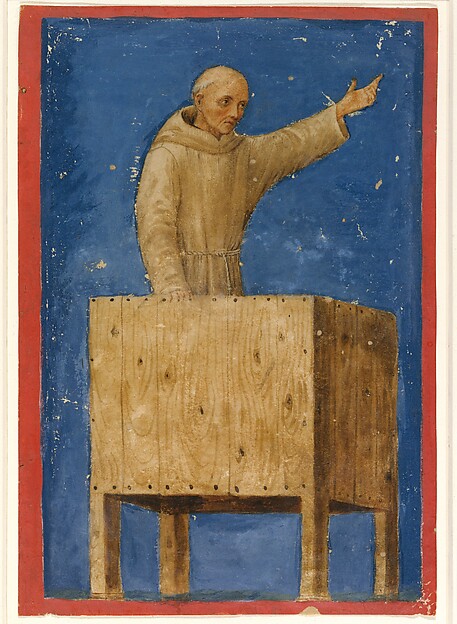
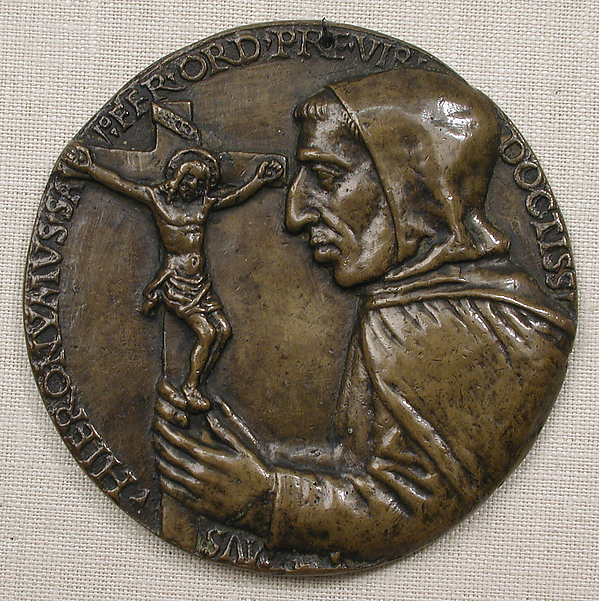
The eighth era ended when the Council of Constance elected Martin V in 1417 and so restored one pope. This era runs from there to Luther’s Ninety-Five Theses in 1517. In those hundred years the Council of Basel claimed authority over the pope and made peace with the Hussites, the Greek and Latin churches proclaimed a union at Florence that the East did not accept, Constantinople fell to the Ottomans, and the popes of the Renaissance rebuilt Rome. Preachers such as Bernardino and Savonarola called for repentance, and an indulgence for the new St Peter’s gave Luther his occasion.
The page is arranged by East and West, as before. Events are tagged East, West or Both.
When were the sources written?
| Writing | Usual date | Notes |
|---|---|---|
| Schaff, History of the Christian Church, vols. 6 and 7 | 1910 edition of vol. 6; vol. 7, second edition, revised | A Protestant church history, used for events and dates |
| The Catholic Encyclopedia | The 1913 edition, on Wikisource | A Catholic reference work, used for events and dates |
| Gibbon, Decline and Fall | 1776 to 1789 | Used here only for Varna and Mehmed II |
Key debates
Should councils rule the church?
The Council of Basel claimed that it did, deposed Eugenius IV and elected a rival pope, but it ended by accepting Nicholas V in 1449. Schaff says Martin V and his successors feared councils and tried to keep them from meeting. The page does not go further than what the sources record.
Did the union of Florence matter?
The decree of union was proclaimed in 1439 and read in Hagia Sophia in December 1452, but Schaff says it was rejected in Constantinople, which fell six months later, and that a Greek council rejected it formally in 1472.
Was the Renaissance papacy a cause of reform?
Schaff, a Protestant, calls Julius II and Leo X worldly and avaricious, and says the rebuilding of St Peter’s gave the occasion for the indulgences Luther attacked. The Catholic Encyclopedia records the general belief that Alexander VI bought his election. Whether the papacy caused the Reformation or only gave it a target, the sources read here do not settle.
Worship and community life
Devotion and the Brothers of the Common Life
Gerrit Groote of Deventer (1340 to 1384) and his followers formed the Brothers of the Common Life. Thomas à Kempis, the probable author of The Imitation of Christ, lived and copied books at Mount St Agnes near Zwolle. Bernardino of Siena preached in the Italian towns, where people burned their games and trinkets, and carried a banner with the monogram of Christ, IHS.
Printing
Schaff dates the invention of the printing press to about 1450, and says Erasmus’s Greek New Testament of 1516 was followed by more than thirty unauthorized reprints.
Glossary
| Term | Meaning on this page |
|---|---|
| Conciliarism | The view that a general council stands above the pope |
| Indulgence | A remission of the temporal punishment for sin, granted by the church |
| Renaissance papacy | The popes of the fifteenth and early sixteenth centuries, who were also patrons of art and learning |
| Utraquism | The Hussite practice of giving communion in both bread and wine |
Further reading
Modern scholarship is cited here, not copied. Titles and years were checked against the Open Library catalogue in November 2026. Nothing on the page rests on these books.
- Joseph Gill, The Council of Florence (1959). The union.
- Eamon Duffy, Saints and Sinners: A History of the Popes (1997). The papacy in the period.
- Peter Partner, Renaissance Rome, 1500 to 1559 (1976). The Renaissance papacy.
Key events
West: The Council of Basel
Summoned by Martin V, the council opened in 1431 and claimed authority over the pope. It declared Eugenius IV deposed in 1439 and elected Amadeus, duke of Savoy, as Felix V. It moved to Lausanne in 1448, accepted Nicholas V as pope, and dissolved on 25 April 1449; Felix then abdicated.
West: The Compacts with the Hussites
Hussite envoys came to Basel in January 1433. The agreement, the Compacts, allowed the laity the cup where they asked for it, on condition that the whole Christ was taught to be present in each element. It was ratified by the Bohemian diet at Iglau on 5 July 1436. The more radical Taborites had been defeated by the Utraquists at Lipan in 1434.
Both: The Council of Ferrara and Florence
The Byzantine emperor and a large Greek delegation came to Ferrara in 1438, and the council moved to Florence in 1439. The decree of union, Laetentur coeli, was proclaimed in Florence cathedral on 6 July 1439; Mark of Ephesus was the only Greek bishop who refused to sign. Schaff says the union was rejected in Constantinople, and that a Greek council there formally rejected it in 1472.
East: The Battle of Varna
A crusading army under Ladislaus, king of Hungary and Poland, marched through Bulgaria to Varna, near the Black Sea coast, where Sultan Murad II destroyed it on 10 November 1444. Ladislaus was killed. The Catholic Encyclopedia says the defeat left Constantinople defenceless.
East: Constantinople falls
Mehmed II took the city on 29 May 1453. The last emperor, Constantine, died fighting at the gate of St Romanos, and Hagia Sophia was turned into a mosque. The articles of the union of Florence had been read in Hagia Sophia only six months before.
West: The Spanish Inquisition is authorized
Sixtus IV's bull of 1 November 1478 allowed the Spanish sovereigns to appoint inquisitors against heretics and to remove and replace them. The first inquisitors were named in 1480.
West: Alexander VI is elected
Rodrigo Borgia was proclaimed pope on 11 August 1492. The Catholic Encyclopedia says it was the general belief that he obtained the office by simony.
West: Savonarola is executed
Savonarola, who had preached reform in Florence, was condemned with two other Dominicans, hanged, and his body burned in Florence in May 1498. Schaff and the Catholic Encyclopedia give 23 May; one passage of the encyclopedia gives 25 May.
West: Work begins on the new St Peter's
Julius II laid the first stone on 18 April 1506, and the same day issued a bull granting an indulgence to those who gave to the building. Schaff says the rebuilding of St Peter's gave the occasion for the indulgences that followed.
West: Erasmus publishes the Greek New Testament
Erasmus published the Greek New Testament in 1516, the first of his five editions. For the last six verses of Revelation, missing from his manuscript, he translated the Latin back into Greek.
West: The indulgence and the Ninety-Five Theses
In 1515 Leo X gave the sale of the indulgence in one part of Germany to Albrecht, archbishop of Mainz, who was allowed to keep half the proceeds; he had borrowed from the Fugger bank to pay for his pallium. On 31 October 1517 Luther posted ninety-five Latin theses on indulgences at the castle church in Wittenberg and sent them to Albrecht. The tenth era begins there.
Key people
Martin V
Elected at the Council of Constance. Schaff says he paid no attention to the reforms promised there, kept the monarchical claims of the papacy, and summoned the next council, at Basel, only under pressure; he notes that the Catholic historian Pastor explains this by Martin's work governing Rome. Martin died in 1431, before Basel met.
Eugenius IV
Quarrelled with the Council of Basel over its authority. In 1437 he moved the council to Ferrara, where the Greeks came, and in 1439 to Florence. The fathers who stayed at Basel declared him deposed in 1439.
Nicholas V
Repaired the Vatican and St Peter's, laid the foundation of the Vatican library, and called scholars to Rome. The Council of Basel accepted him as pope before it dissolved in 1449.
Mehmed II
The son of Murad II. He besieged and took Constantinople on 29 May 1453, and Hagia Sophia was turned into a mosque.
Thomas à Kempis
Born at Kempen, he entered the Augustinian house of Mount St Agnes, was ordained priest in 1413 and became sub-prior in 1429. Schaff says The Imitation of Christ is now generally ascribed to him, but that some scholars of rank dissent, and that France and Italy have claimed its authorship.
Alexander VI
Rodrigo Borgia was proclaimed pope on 11 August 1492. The Catholic Encyclopedia says it was the general belief that he obtained the papacy by simony. Schaff calls him the most corrupt of the Renaissance popes, adding that Catholic historians judge him as harshly.
Julius II
Laid the cornerstone of the new St Peter's on 18 April 1506, to Bramante's design. Michelangelo's frescoes in the Sistine Chapel and Raphael's in the Stanze were made for him, the Catholic Encyclopedia says.
Girolamo Savonarola
Born at Ferrara, he preached repentance in Florence, where his followers burned 'vanities' in the square. He was condemned to death with two other friars, hanged, and his body burned in 1498.
Sources for this era
- History of the Christian Church, volumes 6 and 7, Philip Schaff and David S. Schaff (CCEL)
- The Catholic Encyclopedia (1913), Articles on the Crusades, the Council of Basle, the Council of Florence, Eugene IV, Nicholas V, Sixtus IV, Alexander VI, Julius II and Savonarola (Wikisource)
- The History of the Decline and Fall of the Roman Empire, volume 6, Edward Gibbon (1776 to 1789; Project Gutenberg 736)
- Three works in the Metropolitan Museum of Art, Open Access collection records (objects 461450, 200635 and 831188)
- Modern studies of the period, Joseph Gill; Eamon Duffy; Peter Partner