
The Reformation
Luther's Ninety-Five Theses start a movement that splits western Christendom, princes and cities choose their churches, England breaks from Rome, the Catholic Church reforms itself at Trent, and wars of religion end in the Peace of Westphalia.
Religion in Europe about 1555
Places named on the page: Wittenberg, Worms and Augsburg in the empire, Zurich and Geneva, Trent and Rome, London and Edinburgh, Paris and Nantes, and Prague, where the Thirty Years' War began. No borders are drawn.
Images from the period
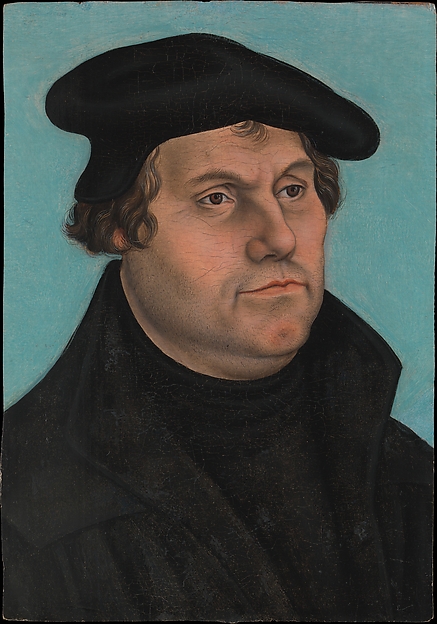
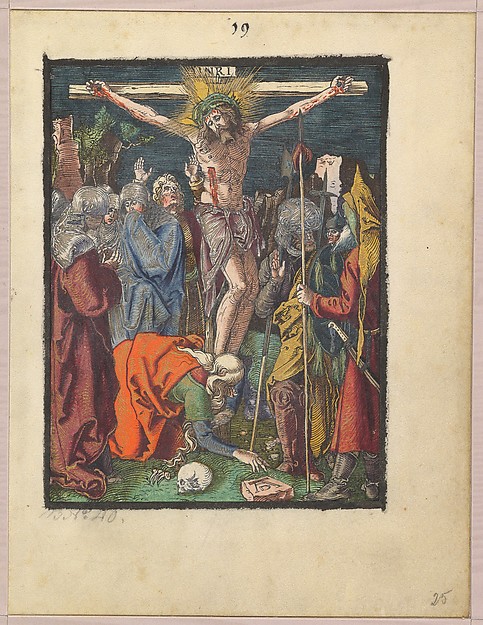
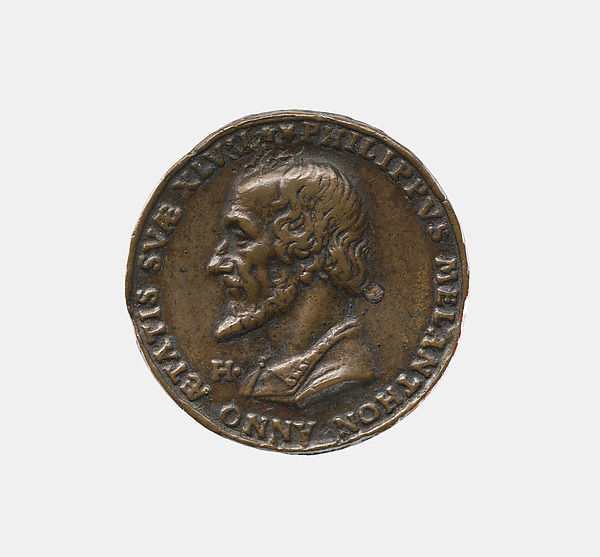
Overview
The ninth era ended with Luther’s Ninety-Five Theses. This era runs from those theses in 1517 to the Peace of Westphalia in 1648. In those years a dispute about indulgences became a movement that split western Christendom. Princes and cities chose their churches, England broke from Rome, the Catholic Church held the Council of Trent, and wars of religion ran through France, the empire and beyond. The peace of 1648 settled the German lands, but it did not end the division of the churches.
The page is arranged by East and West, as before. Events are tagged East or West. The East appears in one event, the confession of Cyril Lucaris.
When were the sources written?
| Writing | Usual date | Notes |
|---|---|---|
| Schaff, History of the Christian Church, vols. 7 and 8 | Late 19th century, revised editions | A Protestant church history, used for events and dates |
| Schaff, Creeds of Christendom, vol. 1 | Sixth edition | The history of the confessions, with extracts |
| Schiller, History of the Thirty Years’ War | 1790s; Morrison’s translation | A literary history, used for the war’s events |
| The Catholic Encyclopedia | The 1913 edition, on Wikisource | A Catholic reference work, used for events and dates |
Key debates
Why did the Reformation succeed where earlier reforms failed?
The sources read here point to several things without weighing them. Schaff gives a section to the printing press, and Luther’s German New Testament appeared in 1522. Princes protected the reform: Schaff describes how each ruler who adopted it took charge of the church in his lands. And Luther’s teaching on justification by faith is at the center of his account. The page does not choose among them.
Could the church have been reformed without a split?
At Marburg the Lutheran and Swiss reformers agreed on fourteen articles of fifteen but could not agree on the Lord’s Supper. At Augsburg in 1530 the emperor heard the Lutheran confession, and the Catholic theologians answered it with a confutation. The Council of Trent reformed the Catholic Church but did not reunite the churches. The sources read here do not say whether a settlement was ever possible.
Did religion cause the wars?
The sources read here describe religious and political causes together. Schaff calls a massacre in the Valtellina in 1620 the work of “religious fanaticism combined with political discontent”, and the Peace of Augsburg tied religion to territory. The page does not decide how far religion was the main cause.
Worship and community life
Preaching and the Bible in the vernacular
Luther’s German New Testament appeared in September 1522 and his whole Bible in 1534, printed with many woodcuts; Schaff says one Wittenberg printer, Hans Lufft, sold about a hundred thousand copies between 1534 and 1574. At Zurich, Luther’s New Testament was adapted to the Swiss dialect in 1524, and the whole Bible was published in German there by Froschauer in 1530, translated in part by Leo Jud and other Zurich divines.
Monasteries and the orders
Henry VIII’s commissioners visited the English monasteries, and Parliament began their suppression in 1536; the Pilgrimage of Grace rose against it that autumn. The Jesuits, approved in 1540, were among the new orders in Catholic lands.
Glossary
| Term | Meaning on this page |
|---|---|
| Indulgence | A remission of the punishment for sin, granted by the church |
| Lutheran | A church or believer following Luther’s teaching |
| Reformed | A church following Zwingli or Calvin, in Switzerland, Scotland, the Netherlands and elsewhere |
| Recant | To withdraw a belief publicly |
| Vernacular | The language people speak, as opposed to Latin |
Further reading
Modern scholarship is cited here, not copied. Titles and years were checked against the Open Library catalogue in November 2026. Nothing on the page rests on these books.
- Diarmaid MacCulloch, The Reformation: Europe’s House Divided, 1490 to 1700 (2003). The framework for the whole era.
- Peter H. Wilson, The Thirty Years War: Europe’s Tragedy (2009). The war from 1618 to 1648.
- Carlos M. N. Eire, Reformations (Open Library lists the 2018 edition). The comparative view.
The Thirty Years' War
The war began in Bohemia in 1618 and spread across the empire. The map marks the places named in the account below and on Schiller's pages. No borders are drawn.
The Thirty Years' War, 1618 to 1648
Prague, where the war began in 1618; Magdeburg, sacked in 1631; Lützen, where Gustavus Adolphus fell in 1632; and Münster and Osnabrück, where the peace was negotiated. No borders are drawn.
Key events
West: The Ninety-Five Theses
On 31 October 1517 Luther posted ninety-five Latin theses on indulgences at the castle church in Wittenberg, invited a public disputation, and sent them to the archbishop of Mainz.
West: Zwingli begins the reform at Zurich
Elected by the chapter at Zurich in December 1518, Zwingli began his work there in 1519. Schaff dates his public career as a reformer from 1519 to 1531.
West: The Diet of Worms
Before Charles V and the diet, Luther said that unless convinced by Scripture or clear arguments, 'I can not and will not recant any thing'. Schaff gives the famous 'Here I stand' as said at least in substance, but notes that a Saxon archivist accepted only the last words, 'God help me. Amen.' The edict placing Luther under the ban of the empire was dated 8 May and published later that month.
West: The German Peasants' War
The revolt broke out in Swabia in the summer of 1524 and spread over south-western and central Germany in 1525. Luther urged its suppression, and the princes, Protestant and Catholic together, crushed it; at Frankenhausen on 25 May 1525 five thousand died. Schaff says the victims of the war far exceeded a hundred thousand.
West: The Marburg Colloquy
Luther and Zwingli met at Marburg in October 1529. They agreed on fourteen of fifteen articles but not on the Lord's Supper, and Luther refused Zwingli's offered hand of brotherhood.
West: The Augsburg Confession
Melanchthon's confession of the Lutheran faith was read aloud in German before Charles V at the Diet of Augsburg on 25 June 1530.
West: The Act of Supremacy
Parliament declared Henry VIII 'the only supreme head, on earth, of the Church of England'. Thomas More and John Fisher were executed for refusing to accept it.
West: The Jesuits are approved
Pope Paul III approved the Society of Jesus, founded by Ignatius of Loyola, on 27 September 1540.
West: The Council of Trent
The council held its first session on 13 December 1545 and closed its sessions on 4 December 1563. Among its decrees was one on Scripture and tradition, in its fourth session.
West: The Schmalkaldic War
Charles V defeated the Schmalkaldic League of the Lutheran princes at Mühlberg on the Elbe on 24 April 1547, and stood at Luther's grave in Wittenberg.
West: The Peace of Augsburg
The peace secured freedom for the Lutheran churches, on the principle that the ruler of a territory decides its religion (cujus regio, ejus religio). The Reformed churches were not formally recognized in the empire until the Peace of Westphalia.
West: The Scottish Reformation
After John Knox's return in 1559 and the death of the queen regent in June 1560, the Scottish parliament met on 1 August 1560, adopted the Protestant Confession of Faith, and abolished papal jurisdiction.
West: St Bartholomew's Day massacre
On St Bartholomew's Day, Sunday 24 August 1572, very many Protestants were murdered in Paris, and the killing was repeated for days in other parts of France. Fugitives reached Geneva on 1 September.
West: The Edict of Nantes
Henry IV of France published the Edict of Nantes, which Schaff says put the Protestants on 'a nearly common footing' with the Roman Catholics.
West: The Thirty Years' War
On 23 May 1618 Bohemian deputies threw two imperial commissioners from a window of the castle at Prague. The war spread across the empire: Tilly's army sacked Magdeburg in 1631, and Gustavus Adolphus of Sweden fell at Lützen in 1632.
East: The confession of Cyril Lucaris
Cyril Lucaris, patriarch of Constantinople from 1621, wrote a confession of faith in Latin in 1629, and in Greek in 1631; it was published at Geneva in 1633. Schaff says eight of its chapters hold the common old Catholic doctrine and the rest are distinctly Protestant. Lucaris was strangled in 1638, and synods at Constantinople, Jassy and Jerusalem condemned the confession.
West: The Peace of Westphalia
After negotiations at Münster and Osnabrück, the peace was signed at Münster on 24 October 1648, Schiller says. Schaff says it embraced the Reformed churches, with the Roman Catholics and Lutherans, in the peace of the empire.
Key people
Martin Luther
Born at Eisleben on 10 November 1483, where he died on 18 February 1546. He posted the Ninety-Five Theses in 1517 and refused to recant at the Diet of Worms in 1521. He taught justification by faith, and translated the Bible into German: the New Testament appeared in September 1522 and the whole Bible in 1534.
Ulrich Zwingli
Elected preacher at Zurich in December 1518, he led its reform from 1519. He differed from Luther on the Lord's Supper, and they failed to agree at Marburg in 1529. He died on the battlefield of Cappel in October 1531, aged forty-seven.
John Calvin
Born on 10 July 1509. The first edition of his Institutes of the Christian Religion appeared at Basel in March 1536. He came to Geneva that year, was banished in 1538, and returned in 1541, staying until his death on 27 May 1564. Schaff says Calvin and Beza connect the Swiss Reformation with France, Holland, England and Scotland.
Philipp Melanchthon
Published the Loci communes, his 'Theological Common-Places', in 1521; Schaff says the book marks an epoch in the history of theology. He wrote the Augsburg Confession of 1530, which Schaff says is in content Luther's as much as his, but in form altogether Melanchthon's.
Charles V
Born at Ghent on 24 February 1500, already king of Spain when his grandfather, Emperor Maximilian I, died in January 1519 and the imperial crown passed to him. He tried to restore religious unity, and defeated the Protestant princes at Mühlberg in 1547. He abdicated at Brussels in 1555.
Henry VIII
Sought to end his marriage to Catherine of Aragon from about 1527. In 1534 Parliament declared him 'the only supreme head, on earth, of the Church of England'. Thomas More and John Fisher were executed for refusing it, and the monasteries were suppressed from 1536.
Ignatius of Loyola
Ignatius and his companions offered their services to Pope Paul III, who approved the Society of Jesus by the bull Regimini militantis ecclesiae on 27 September 1540.
Elizabeth I
Under Elizabeth the Thirty-nine Articles of 1563 became the doctrinal standard of the Church of England. Their thirty-seventh article claims for 'the Queen's Majesty the chief power in this Realm of England'.
Sources for this era
- History of the Christian Church, volumes 7 and 8, Philip Schaff (CCEL)
- The Creeds of Christendom, volume 1: The History of Creeds, Philip Schaff (sixth edition; CCEL)
- The Catholic Encyclopedia (1913), Articles on Henry VIII, the Society of Jesus, St. Ignatius Loyola and Scotland (Wikisource)
- The History of the Thirty Years' War, Friedrich Schiller; translated by A. J. W. Morrison (Project Gutenberg, ebook 6775)
- Three works in the Metropolitan Museum of Art, Open Access collection records (objects 436047, 361985 and 855362)
- Modern studies of the period, Diarmaid MacCulloch; Peter Wilson; Carlos Eire