
Reform and Crusade
Popes and kings struggle over the appointment of bishops, crusaders take Jerusalem and later Constantinople, new orders of monks and friars spread across the West, and the Fourth Lateran Council of 1215 defines the Eucharist and requires yearly confession.
Reform and crusade, about 1100
Places in the struggle over the papacy and the call to the First Crusade: Hastings and Canterbury, Clermont and Cîteaux, Canossa and Rome, Venice, and the road through Constantinople and Antioch to Jerusalem. No borders are drawn.
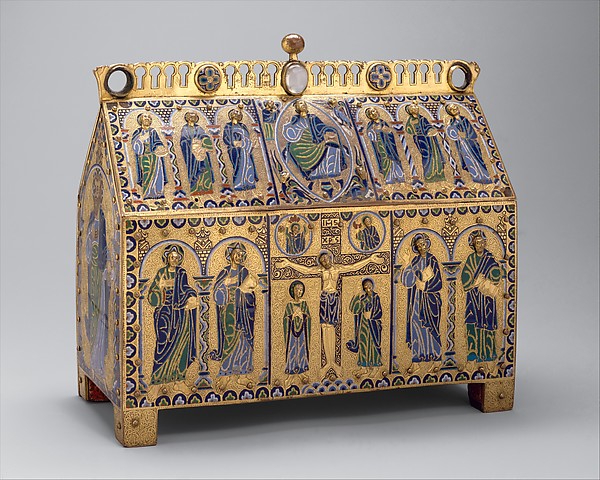
Images from the period
Overview
The sixth era ended with the excommunication of 1054. This era runs from there to the Fourth Lateran Council of 1215. In those years popes and kings fought over who should appoint bishops, western armies went on crusade to the East, new orders of monks and then of friars spread across the West, and a great council defined the Eucharist and the duties of every Christian.
The page is arranged by East and West, as before. Events are tagged East, West or Both. The sources read for it are Western: medieval documents in translation, and three later histories that disagree on some dates. Where they disagree, the page gives both.
When were the sources written?
| Writing | Usual date | Notes |
|---|---|---|
| Gregory VII’s letter to the German princes | 1077 | Read in Ogg’s translation |
| Accounts of Urban II’s speech (Fulcher, Robert the Monk) | Written by men present at Clermont | Read in Thatcher and McNeal’s translation |
| Villehardouin, Memoirs | By a leader of the Fourth Crusade | Marzials’s translation, 1908 |
| Decrees of the Fourth Lateran Council | 1215 | Canon 1 read only in the Latin Schaff quotes; canon 21 in Thatcher and McNeal’s note |
| Gibbon, Decline and Fall | 1776 to 1789 | A modern history, used for events only |
| Schaff, History of the Christian Church, vol. 5 | 1907 | A Protestant church history, used for events and dates |
| The Catholic Encyclopedia | The 1913 edition, on Wikisource | A Catholic reference work, used for events and dates |
Key debates
Who should appoint bishops?
Gregory VII forbade kings to invest bishops, and Henry IV’s bishops declared him deposed in 1076. Canossa did not end the quarrel. The Concordat of Worms in 1122 was a compromise: the church gave bishops the ring and crosier, and the emperor gave them their lands with the sceptre. Schaff and Ogg judge Canossa differently, as the event above shows.
Why did the crusades go where they did?
The First Crusade was called to help the Christians of the East and to reach Jerusalem. The Fourth turned first to Zara, to pay the Venetians, and then to Constantinople, to restore a deposed emperor in return for his son’s promises. Innocent III forbade both attacks and condemned the sack. The sources read here describe how the diversion happened but do not settle whether anyone planned it from the start.
What was the role of the friars?
Francis and his companions lived in poverty and preached, and Innocent III approved their way of life in 1209 or 1210. Schaff treats the Franciscans and Dominicans together as the mendicant orders. This page does not go further into their work, which belongs mostly to the next era.
Worship and community life
Monasteries and the reform of religious life
Robert of Molesme settled with twenty companions near Cîteaux in 1098, and the Cistercians who followed him made manual labour an essential part of monastic life. Schaff says new houses followed rapidly and spread over all Western Europe. Bernard of Clairvaux was the order’s most famous monk.
Law and the schools
Gratian, a monk who taught at Bologna, compiled his collection of church law, the Concordance of Discordant Canons or Decretum, about 1140 to 1150. Schaff says it at once became the standard manual of canon law.
Glossary
| Term | Meaning on this page |
|---|---|
| Canon law | The law of the church, set out in councils, decrees and collections |
| Crusade | An armed expedition called by the church, such as those to the East named on this page |
| Investiture | The formal giving of office to a bishop or abbot; at Worms, the ring and crosier by the church and the sceptre by the emperor |
| Simony | The buying and selling of church offices |
| Transubstantiation | The teaching that the bread and wine of the Eucharist become Christ’s body and blood |
Further reading
Modern scholarship is cited here, not copied. Titles and years were checked against the Open Library catalogue in November 2026. Nothing on the page rests on these books.
- R. I. Moore, The First European Revolution, c. 970 to 1215 (2000). The framework for the period.
- Christopher Tyerman, God’s War: A New History of the Crusades (2006). The crusades.
- Giles Constable, The Reformation of the Twelfth Century (1996). The reform movements.
The Crusades, 1096 to 1204
Routes and battles of four crusades. Routes are drawn straight between places and are simplified. The dates in the notes come from Schaff, the Catholic Encyclopedia and Villehardouin, named in each note.
The First Crusade, 1096 to 1099
The route of the crusading armies from Constantinople to Jerusalem, drawn straight between places, with the sieges and battles that marked it. Gibbon traces the march across Asia Minor by Dorylaeum, Iconium and Erekli (Heraclea); Tancred and Baldwin turned aside to Tarsus, and Baldwin went on to Edessa.
- 1Nicaea, Besieged for seven weeks, Gibbon says. The emperor Alexius had it surrendered to himself and kept the crusaders out, in June 1097 (1 June in the Catholic Encyclopedia, 19 June in Schaff).
- 2Dorylaeum, The Turks surprise one of the two crusading columns; the crusaders defeat them on 1 July 1097.
- 3Antioch, Reached on 20 October 1097 and taken on the night of 2 June 1098; the next day the crusaders are besieged inside it, until they drive off Kerbogha's army on 28 June.
- 4Jerusalem, Besieged from 7 June 1099 and entered on 15 July; the crusaders kill its inhabitants, the Catholic Encyclopedia says.
- 5Ascalon, An Egyptian army is defeated here on 12 August 1099.
The Second Crusade, 1147 to 1149
Conrad III and Louis VII cross Anatolia, meet at Nicaea and go on to Ephesus; Louis sails from Attalia to Antioch, and the crusade fails before Damascus in July 1148. Edessa, whose fall in 1144 led to the crusade, is marked. The route is drawn straight between places and is simplified.
- 1Nicaea, The German and French kings meet here in 1147 and go on together to Ephesus.
- 2Attalia, Louis leaves the body of his army to go on by land and sails to Antioch.
- 3Damascus, Besieged by the combined crusade; it retreats after a few weeks, in July 1148. Schaff blames quarrels among the leaders.
The Third Crusade, 1189 to 1192
Richard I's route by sea from Messina, by way of Cyprus, to Acre and Jaffa, drawn straight between places. Frederick Barbarossa's army went overland and took Iconium, and he drowned crossing the river Selef (Kalykadnos) in the Taurus region in 1190. Hattin, where Saladin defeated the army of Jerusalem in 1187, is marked for background.
- 1Cyprus, Shipwrecked on the coast in 1191, Richard conquers the island from Isaac Comnenus.
- 2Acre, Besieged from June 1189; it capitulates on 13 July 1191, after the kings of France and England arrive, and becomes the crusaders' base.
- 3Jaffa, Richard defends it against Saladin in 1192; after a truce he sails for Europe on 9 October 1192, without having entered Jerusalem.
The Fourth Crusade, 1202 to 1204
The fleet's route from Venice by way of Zara, Corfu and Negropont to Constantinople, drawn straight between places, as Villehardouin describes it. At Zara in 1202 and at Constantinople in 1203 and 1204 the crusade fought against Christians.
- 1Zara, The crusaders come before Zara on 10 November 1202 and take it for Venice, though an abbot forbids the attack in the pope's name; they winter there.
- 2Corfu, The host gathers here with the young Alexius and sails on the eve of Pentecost, 24 May 1203.
- 3Negropont, The fleet reaches Negropont, 'a very fair island', on its way east in 1203.
- 4Scutari, On 24 June 1203 the fleet crosses to the Asian shore at Chalcedon and Scutari. After the assault of 17 July the emperor Alexius III flees, and the blinded Isaac is restored.
- 5Constantinople, Taken on the Monday after Palm Sunday, 12 April 1204, and plundered.
Key events
West: The Norman conquest of England
William, duke of Normandy, defeated Harold at Hastings on Saturday 14 October 1066, Ogg says. Schaff says William deposed Archbishop Stigand and other Saxon bishops to make room for Normans, and made Lanfranc, abbot of St Stephen's at Caen in Normandy, archbishop of Canterbury.
West: Canossa
After Gregory VII excommunicated him, Henry IV crossed the Alps in winter and came to the castle of Canossa, where the pope was staying. Schaff says he stood in the courtyard as a penitent from 25 to 28 January before Gregory absolved him. Gregory's own letter to the German princes describes the king 'humbled to penance'. Historians have judged it differently: Schaff calls it a 'signal triumph' for Gregory 'but only for a short time', and Ogg says Henry won a temporary advantage, while in the long run the episode told against the king.
Both: The Council of Clermont calls the First Crusade
Envoys of the Byzantine emperor Alexius had asked for help against the Turks at Piacenza earlier in 1095. At Clermont, on 27 November 1095, Urban II urged the crowds to go to the aid of the Christians of the East and to Jerusalem. The speech survives in the accounts of four writers who were present, which differ in their wording.
Both: Crusaders take Jerusalem
The crusaders began the siege on 7 June 1099, attacked on 14 July and entered the city on 15 July. The Catholic Encyclopedia says they 'slew its inhabitants regardless of age or sex'. Schaff gives the chroniclers' account of the massacre, and calls their claim that blood in the temple area reached the horses' knees an exaggeration.
West: The Concordat of Worms
Pope Calixtus II and the emperor Henry V signed a compromise on 23 September 1122. Bishops were to be invested with the ring and crosier, the signs of their spiritual office, by the church, and with their lands by the emperor's sceptre.
West: Abelard condemned at Sens
Peter Abelard asked for a council at Sens to debate with Bernard of Clairvaux. On the eve of the council the bishops, with Bernard present, condemned propositions from Abelard's writings, and Pope Innocent II confirmed the sentence. Abelard died in 1142, after Peter the Venerable, abbot of Cluny, had taken him in and reconciled him with Bernard.
West: Thomas Becket is murdered
Four knights came from France to Canterbury and killed Becket in his cathedral on 29 December 1170. The Catholic Encyclopedia says it is not quite clear how far Henry II was directly responsible. Becket was canonized two years later, on 21 February 1173.
Both: Saladin takes Jerusalem
Saladin's army destroyed the army of the kingdom of Jerusalem near Lake Tiberias, at Hattin, on 4 July 1187 (the Catholic Encyclopedia) or 5 July (Schaff). Jerusalem fell soon after: Schaff says Saladin entered it on 2 October, while the Catholic Encyclopedia gives 17 September for its surrender. The Third Crusade followed.
East: The Fourth Crusade takes Zara, then Constantinople
Unable to pay Venice for its ships, the crusaders agreed to take Zara for the Venetians. Villehardouin says they came before it on 10 November 1202, though an abbot forbade the attack in the pope's name 'for those within it are Christians'. The pope took the capture ill. The crusaders then took up the cause of the deposed emperor Isaac and his son Alexius, and took Constantinople on 12 April 1204. Villehardouin says never had so much booty been won in any city. The Latin empire that followed lasted until 1261, Schaff says.
West: Innocent III approves the Franciscans
Francis and some of his companions went to Rome and were received by Innocent III, who approved their way of life. Schaff gives both dates.
Both: The Fourth Lateran Council
The council met in the Lateran on 11, 20 and 30 November 1215, with 412 bishops and 800 abbots and priors (Schaff) or 900 (the Catholic Encyclopedia). Its first canon defined the Eucharist in terms of transubstantiation: the bread and wine are 'transubstantiated' into Christ's body and blood. Its twenty-first required every Christian to confess at least once a year to their own parish priest. It also issued a decree for a crusade.
Key people
Gregory VII
Called Hildebrand before his election in April 1073. He fought simony and the marriage of priests, and quarrelled with the German king Henry IV over the investiture of bishops. Henry's bishops declared him deposed at Worms in January 1076; Gregory excommunicated Henry, then absolved him at Canossa in 1077. When the conflict broke out again, Gregory was driven from Rome and died at Salerno on 25 May 1085.
Urban II
Called for the First Crusade at the Council of Clermont in November 1095. Four writers who were at Clermont reported his speech; Schaff calls their accounts supplementary rather than contradictory, but none can be taken as his exact words. He died on 29 July 1099, two weeks after the crusaders took Jerusalem.
Bernard of Clairvaux
A Cistercian monk who founded Clairvaux in 1115 with twelve companions. He preached the Second Crusade at Vézelay at Easter 1146, and that Christmas won over the emperor Conrad III at Speyer. He opposed a monk who was stirring up attacks on the Jews of the Rhineland. He denounced Peter Abelard, whose teaching was condemned at the council of Sens in 1141.
Thomas Becket
Henry II's chancellor from 1155, consecrated archbishop on 3 June 1162. He quarrelled with the king over the rights of the church and its courts, set out in the Constitutions of Clarendon of 1164. He was killed in Canterbury Cathedral on 29 December 1170 and canonized on 21 February 1173. In 1174 Henry did public penance at his tomb.
Innocent III
Called the Fourth Crusade and presided over the Fourth Lateran Council in 1215. He excommunicated the crusaders who took Zara, and threatened them with continued excommunication if they turned against Constantinople. After the sack he wrote that they had spared 'nothing that is sacred, neither age nor sex'.
Francis of Assisi
Gave up his family's wealth for a life of poverty and preaching. In 1209 or 1210 he and some companions went to Rome and were received by Innocent III, who approved their way of life. Schaff says 1209 is the date usually given and that the historian Sabatier argued for 1210.
Sources for this era
- Memoirs or Chronicle of the Fourth Crusade and the Conquest of Constantinople, Geoffroi de Villehardouin; translated by Frank T. Marzials (1908; Project Gutenberg 6032)
- A Source Book for Mediaeval History, Oliver J. Thatcher and Edgar Holmes McNeal (1905; Project Gutenberg, ebook 42707)
- A Source Book of Mediaeval History, Frederic Austin Ogg (1907; Project Gutenberg, ebook 39227)
- History of the Christian Church, volume 5: The Middle Ages, 1049 to 1294, Philip Schaff and David S. Schaff (CCEL)
- The Catholic Encyclopedia (1913), Articles on the Crusades, Gregory VII, Innocent III, Thomas Becket, Peter Abelard, Lanfranc and the Fourth Lateran Council (Wikisource)
- The History of the Decline and Fall of the Roman Empire, volume 5, Edward Gibbon (1776 to 1789; Project Gutenberg 735)
- Chasse with the Crucifixion and Christ in Majesty, Metropolitan Museum of Art, Open Access collection record (object 464483)
- Modern studies of the period, R. I. Moore; Christopher Tyerman; Giles Constable